

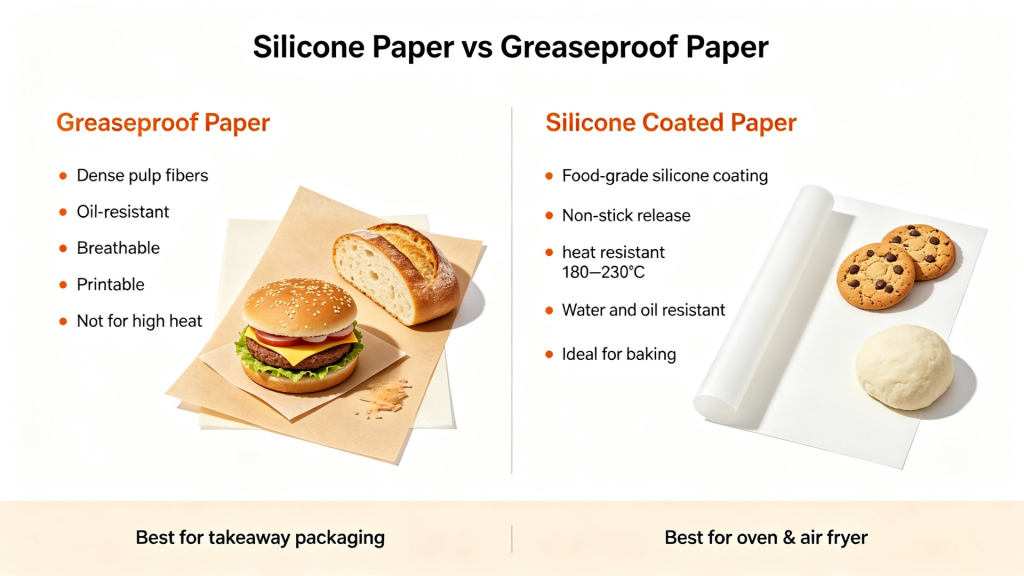
Silicone Paper vs Greaseproof Paper – Key Differences
Core principle: Greaseproof paper relies on dense pulp fibers for oil resistance (no silicone coating); silicone paper is base paper coated with food-grade silicone oil, featuring non-stick property and high temperature resistance.
These two terms are often confused in daily naming, and they cannot be substituted arbitrarily.
- Manufacturing Principle & Structure
Greaseproof Paper (Silicone-Free Greaseproof Paper)
Wood pulp undergoes intensive beating. Cellulose fibers are tightly interlaced with tiny pores. It blocks grease by its physically dense structure without surface coating.
Notes: There are also a small number of PE-laminated greaseproof paper and fluorinated greaseproof paper (PFAS-containing fluorochemicals are gradually restricted in the food industry).
Silicone Coated Paper (Baking Paper)
Base paper (usually greaseproof paper or glassine paper) is coated with food-grade silicone oil on one or both sides. Low surface energy of silicone oil delivers water resistance, oil resistance and excellent non-stick performance.
Performance Comparison Table
| Comparison Item | Greaseproof Paper | Silicone Coated Paper |
|---|---|---|
| Core Advantages | Oil-resistant, breathable, lower cost, printable | Non-stick demolding, high temperature resistance, both water and oil resistant |
| Non-stick Property | Poor; dough or meat tends to stick to paper after heating | Excellent; food can be peeled off easily without adhesion |
| Temperature Resistance | Conventional natural greaseproof paper: ≤120°C. Prone to carbonization and ignition under prolonged high-temperature baking. NOT suitable for ovens or air fryers | Standard food grade: 180–230°C. Safe for ovens, air fryers and steaming |
| Air Permeability | Good, allows water vapor to pass through | Relatively dense silicone layer, less breathable than greaseproof paper |
| Waterproof Performance | Only oil-resistant; not waterproof. Becomes soft when exposed to soup or water | Hydrophobic silicone layer, resistant to both water and oil |
| Surface Texture | Matte, natural paper texture, non-slippery | Smooth surface with slippery silicone feel |
| Printing Compatibility | Easy ink absorption, suitable for logo printing (burger wraps, snack packaging) | Silicone layer repels ink. Conventional printing cannot adhere well; only screen printing or hot stamping is applicable |
| Price | Lower | Higher cost than greaseproof paper |
- Applicable Scenarios (Critical for Purchase)
Suitable for Greaseproof Paper
Room-temperature / low-temperature food packaging. NOT for prolonged high-temperature baking
Burger wrapping paper, fried food packaging, crepe paper bags, bread separating sheets
Tray liner paper, dessert base paper, cold food wrapping
Takeaway packaging requiring printed patterns and brand logos
Suitable for Silicone Coated Paper
High-temperature cooking and scenarios requiring non-stick demolding
Oven tray liners, cookie & cake baking, mooncake demolding
Air fryer liners, barbecue paper, steaming paper for buns
Separator for frozen raw dough and scenarios preventing food sticking together - Common Misunderstandings
❌ Misconception: Greaseproof Paper = Silicone Paper
Many suppliers generally refer to silicone coated paper as “greaseproof paper”, which causes naming confusion. Clearly confirm whether silicone coating is included when placing orders.
❌ Misconception: Greaseproof paper can be used in ovens
Conventional natural greaseproof paper has poor heat resistance. It easily becomes brittle and charred above 120°C. Do not use it in air fryers for baking.
❌ Misconception: Silicone paper has good air permeability
The silicone coating provides high tightness. When steaming food with plenty of soup, water vapor hardly escapes and tends to form condensed water. - Quick Selection Guide
For takeaway packaging, printed burger/snack wraps → Greaseproof Paper
For baking, ovens, air fryers, anti-stick cooking needs → Silicone Coated Paper