

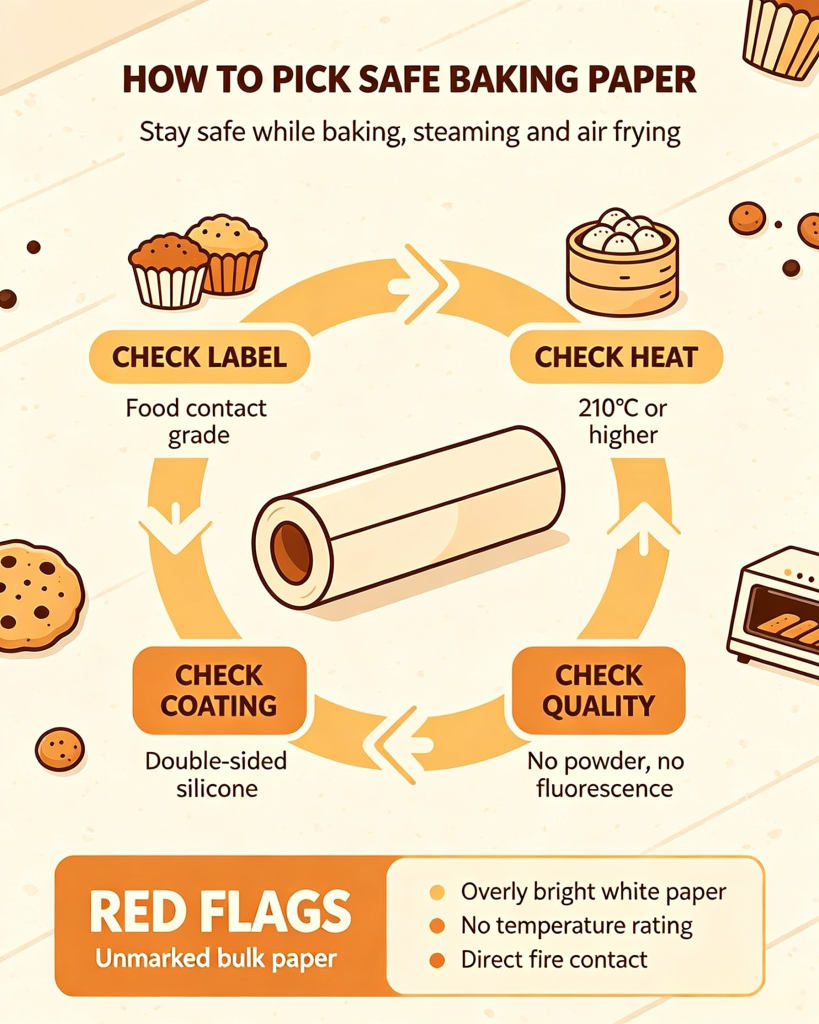
How Consumers Can Choose Safe and Sanitary Baking Paper?
There are two main types of baking paper on the market: food-grade silicone oil paper (the most commonly used) and uncoated plain baking paper. Low-quality products carry risks such as silicone oil migration, fluorescent whitening agents, recycled pulp, and release of harmful substances at high temperatures. Below is a step-by-step guide for selection.
- Check Product Labelling First (Primary Criterion)
Must be marked: For Food Contact / Food Grade
The package should state “Paper and paperboard for food contact”, with the national standard:
✅ GB 4806.8-2016 National Food Safety Standard: Materials and Products of Paper and Paperboard for Food Contact
Do not use products without this standard code for direct food contact.
Check the temperature resistance rating
Premium silicone oil paper generally withstands temperatures ranging from -60°C to 220°C.
Note: Avoid prolonged use above 220°C (high-temperature crisp baking, stone baking), as the silicone coating will decompose rapidly. For ovens and air fryers, choose products heat-resistant to at least 210°C.
Distinguish single-sided vs double-sided silicone oil paper
Double-sided silicone coating: Better non-stick performance, suitable for baking tray lining, steaming and roasting.
Single-sided silicone coating: Lower cost. Ensure the silicone-coated side touches food.
❌ Warning: Avoid unpackaged bulk baking paper sold in simple transparent plastic bags without printed specifications; these are likely uncertified products. - Key Knowledge about Material and Coating
Is silicone oil safe?
Genuine baking paper adopts food-grade methyl silicone oil, which is stable under normal room temperature and baking conditions with low risk of precipitation.
⚠️ Potential hazards arise from:
Industrial waste silicone oil (non-food raw materials);
Loose base paper of inferior products, causing massive silicone oil migration into food under high heat;
Baking continuously exceeding the rated temperature.
Watch out for fluorescent baking paper
Simple home test:
Turn off the light and shine the UV light function of your phone flashlight onto the paper.
Bright bluish-white glow in large areas = contains fluorescent whitening agents, not recommended for contact with oily food.
Only faint reflection without strong blue luminescence = relatively safe.
Tip: Be extra cautious of overly white baking paper. Virgin pulp food-grade paper will not be unnaturally brilliant white. - Practical Visual & Tactile Selection Tips
Texture test
High-quality paper: Tough, free of powder shedding; no white residue rubs off when crumpled.
Low-quality paper: Thin, brittle and prone to breakage; tends to stick to food.
Water drop test (easy home inspection)
Drop clean water onto the paper surface. Qualified paper keeps water droplets intact without penetration.
Rapid water penetration indicates porous base paper, which allows easy migration of grease and silicone oil.
Oil test
Drip a small amount of cooking oil and let it sit. Good paper resists heavy oil seepage. - Recommendations for Different Usage Scenarios
Oven baking for biscuits, cakes and cookies
Preferred choice: Double-sided food-grade silicone oil paper with heat resistance ≥ 210°C.
Air fryer use
Choose moderately thick paper; overly thick sheets obstruct hot air circulation. Do not wrap food tightly for baking to prevent local overheating.
Steaming buns and steamed cakes
Silicone oil paper can be used for short-term steaming. Steaming paper is more suitable for prolonged steaming, as silicone oil carries higher migration risks in sustained steam environments than dry baking.
High-temperature grilling above 230°C
Minimize the use of silicone oil paper; high-temperature silicone baking mats are a better alternative. - Critical Usage Precautions (Proper selection plus proper use)
Keep away from open flame! Baking paper is flammable. Avoid direct contact with oven heating elements.
Do not heat empty baking paper without food.
When baking high-fat ingredients (pork belly, egg tarts, buttery desserts) at high temperatures, shorten baking time as much as possible; grease accelerates silicone oil migration.
Do not reuse one sheet repeatedly for a long time. Replace immediately once the coating wears off.
Avoid heating silicone oil paper in a microwave oven on high power for extended periods. - Clarification of Common Misconceptions
❌ Myth 1: More expensive baking paper is safer
Price differences for similar products mostly come from branding and thickness. Certification standard marking matters more; a higher price does not guarantee compliance.
❌ Myth 2: Silicone-free baking paper is always superior
Uncoated plain baking paper sticks easily to food and requires oil brushing. It works only for specific baking purposes and is not an all-purpose option.
❌ Myth 3: White paper is unsafe, and natural kraft paper is always safe
Unbleached kraft paper may still use non-food-grade base stock. Always check for the GB 4806.8 marking. - Quick Selection Checklist for Shopping
✅ Printed on packaging: For food contact paper + GB 4806.8-2016
✅ Marked temperature resistance ≥ 210°C
✅ No obvious fluorescence under UV light
✅ No powder shedding, good water resistance
❌ Reject unlabelled bulk products, fluorescent ultra-white paper, and items without temperature resistance specifications